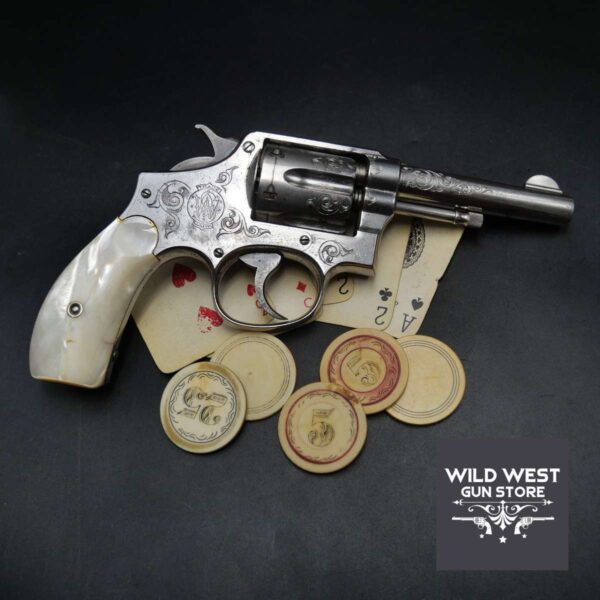
Often overlooked because of their rarity, this little-known family of Smith & Wesson Hand Ejector revolvers deserves special attention, especially as some of these models are classified in France as Category D historical firearms and are highly sought after by collectors.
While the break-top Smith & Wesson revolvers, known as break barrel revolvers, with a frame that hinges downward for reloading, have become classics of 19th-century black powder and Old West collecting, the first swing-out cylinder revolver model, known as the Hand Ejector, remains relatively unknown.
The side-swinging cylinder system was not an innovation unique to Smith & Wesson; it had previously been introduced by Colt as early as 1889, and later on the 1892, 1894, 1901, and 1903 models.
However, the advent of smokeless powder, which generated significantly higher pressures, prompted Smith & Wesson to adapt its production by developing a stronger solid-frame revolver equipped with a fast-loading swing-out cylinder system: thus was born the Hand Ejector family.
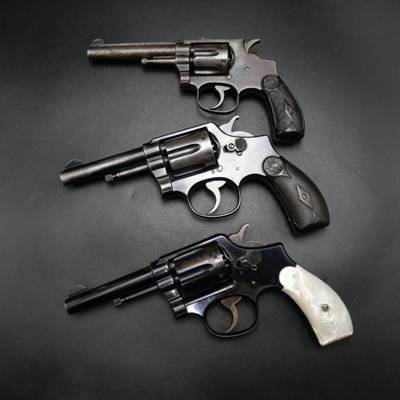
From top to bottom: .32 S&W Long caliber,
.32-20 caliber, .38 S&W Special caliber
The first model was introduced in 1896 in .32 S&W Long caliber, followed in 1899 by the .32-20, .38 S&W Special, and .38 Long Colt calibers, marking a true technical breakthrough in Smith & Wesson production. This lineage would give birth to the iconic Hand Ejector and later Military & Police series, whose designation still survives today in modern pistols such as the M&P 9.
The so-called "first type" models are the only ones classified as Category D in France, while their successors are classified as Category B.
Several criteria make them identifiable, but the most obvious is the absence of a locking lug beneath the barrel to support the cylinder axis: none of the first models (.32, .32-20, .38 Special, .38 Long Colt) are equipped with one.
Despite their rarity, these first models and their successors enjoyed significant production runs:
- The .32 S&W Long model, introduced in 1896, was produced until 1942, with more than 530,000 manufactured.
- The .32-20 model, introduced in 1899, was manufactured until 1940, with approximately 144,000 produced.
- The .38 S&W Special model, also introduced in 1899, was produced until 1905, with 62,449 units manufactured before being replaced by the 1905 model.
- Finally, the .38 Long Colt model was produced in only 2,000 examples to fulfill a specific order from the U.S. Army and U.S. Navy.
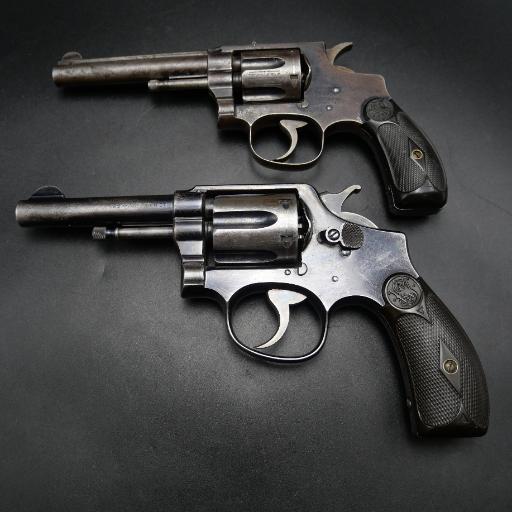
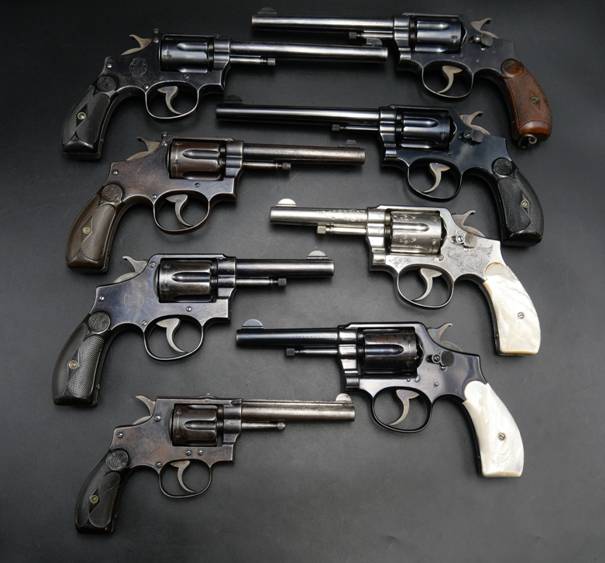
The frame of the .32-20 model (bottom) is significantly larger than that of the .32 S&W Long
The S&W .32 Hand Ejector First Model D.A. is the most common of the 1st Models. Produced from 1896 to 1903 in 19,712 examples, it was chambered exclusively in .32 S&W Long and offered with 3¼", 4¼", and 6" barrels. The markings (address and patents) are engraved on each side of the cylinder, the logo is located on the right side of the frame, and there is no caliber marking.
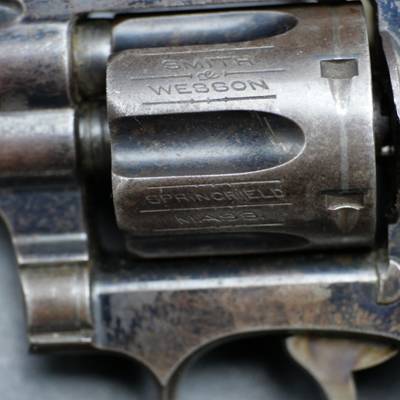
The cylinder of the .32 S&W Long model
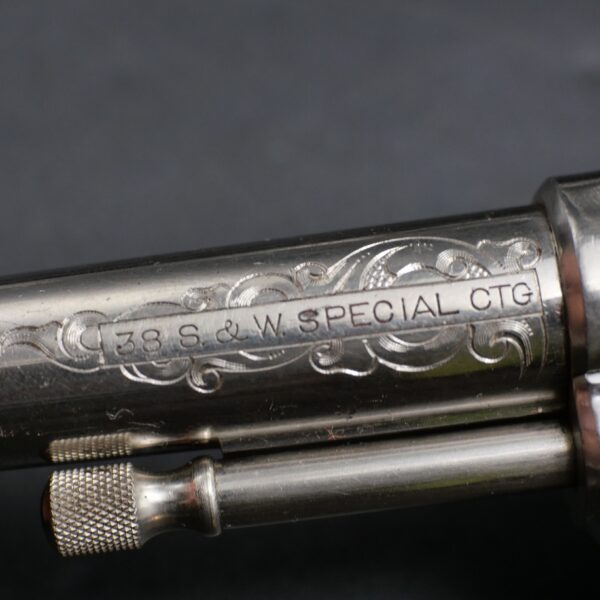
The S&W .32-20 Hand Ejector First Model D.A., much rarer, was produced in only 5,311 examples from 1899 to 1902. Chambered in .32-20 and available with 4", 5", and 6" barrels, it uses a larger frame identical to that of the .38 model. The markings are located on top of the barrel, the caliber designation "32 Winchester CTG" is engraved on the left side, and the logo appears on the frame. It should be noted that the engravings are extremely fine.
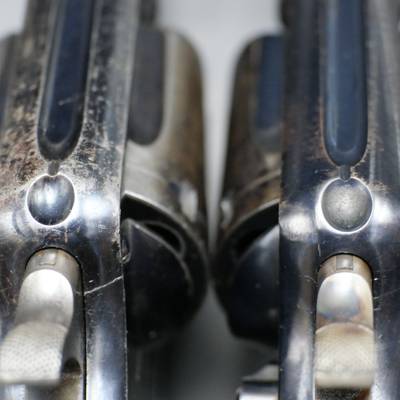
The frame of the .32-20 model is identical to that of the .38 S&W Special
A factory target-sighted version exists and, according to Flayderman, is worth three to five times more than the standard model.
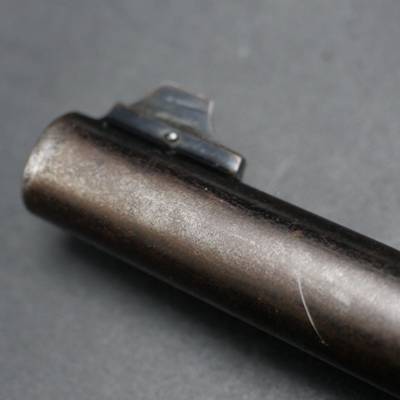
The "target" version
The S&W .38 Hand Ejector M&P 1st Model, produced from 1899 to 1902 in 20,975 examples (including military versions), was chambered in .38 S&W Special. Its markings are identical to those of the .32-20 model except for the caliber designation. The earliest examples do not have the caliber marking engraved on the side of the barrel.

The S&W .38 Hand Ejector M&P 1st Model – U.S. Army & U.S. Navy was part of a military contract awarded in 1900. The U.S. Navy received 1,000 revolvers at the end of 1900, followed by 1,000 more for the U.S. Army in April 1901. These revolvers, chambered in .38 Long Colt, bear the marking "S.W. 38 MIL" on the left side of the barrel (probably to avoid writing "Colt" on a Smith & Wesson revolver).
They feature checkered wooden grips marked "J.T.T. 1901" on one side (John T. Thompson) and "K.S.M." on the other. Inspection marks are found on the frame, barrel, and cylinder. The U.S. Army or U.S. Navy designation is engraved on the butt, accompanied by an anchor (Navy) or a lanyard ring (Army). Serial numbers range from 13,001 to 14,000 for the Army and from 5,001 to 6,000 for the Navy, with an additional numbering sequence from 1 to 1,000 for the latter.
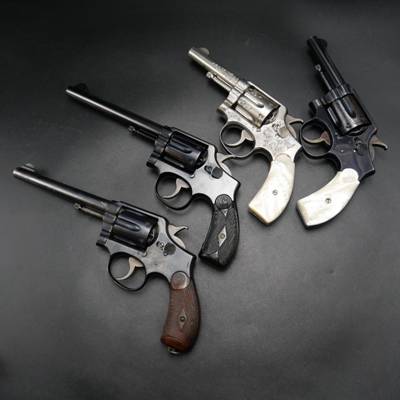
Family photo in .38 caliber
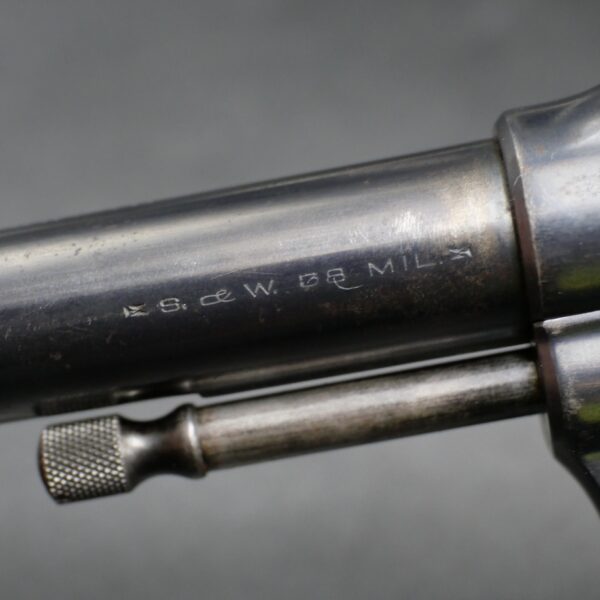
The military caliber marking
Finally, "factory engraved" firearms, meaning engraved at the factory by Smith & Wesson master engravers, are truly exceptional pieces that are seldom encountered in collections.
Engraving detail